Introduction
If your dog can turn their head away from you for five seconds and somehow discover a sandwich, loaf of bread, or freshly cooked meal, you are not alone. How to stop counter surfing is a common training question because dogs are naturally interested in food, smells, and anything they can investigate. The good news is that counter surfing is a learned habit, which means it can be changed.
The most effective approach is not simply telling your dog “no.” Instead, you need to prevent the behavior from being rewarded while teaching your dog what to do instead. Keeping counters clear, managing kitchen access, and rewarding calm behavior can make a major difference.
What Is Counter Surfing in Dogs?
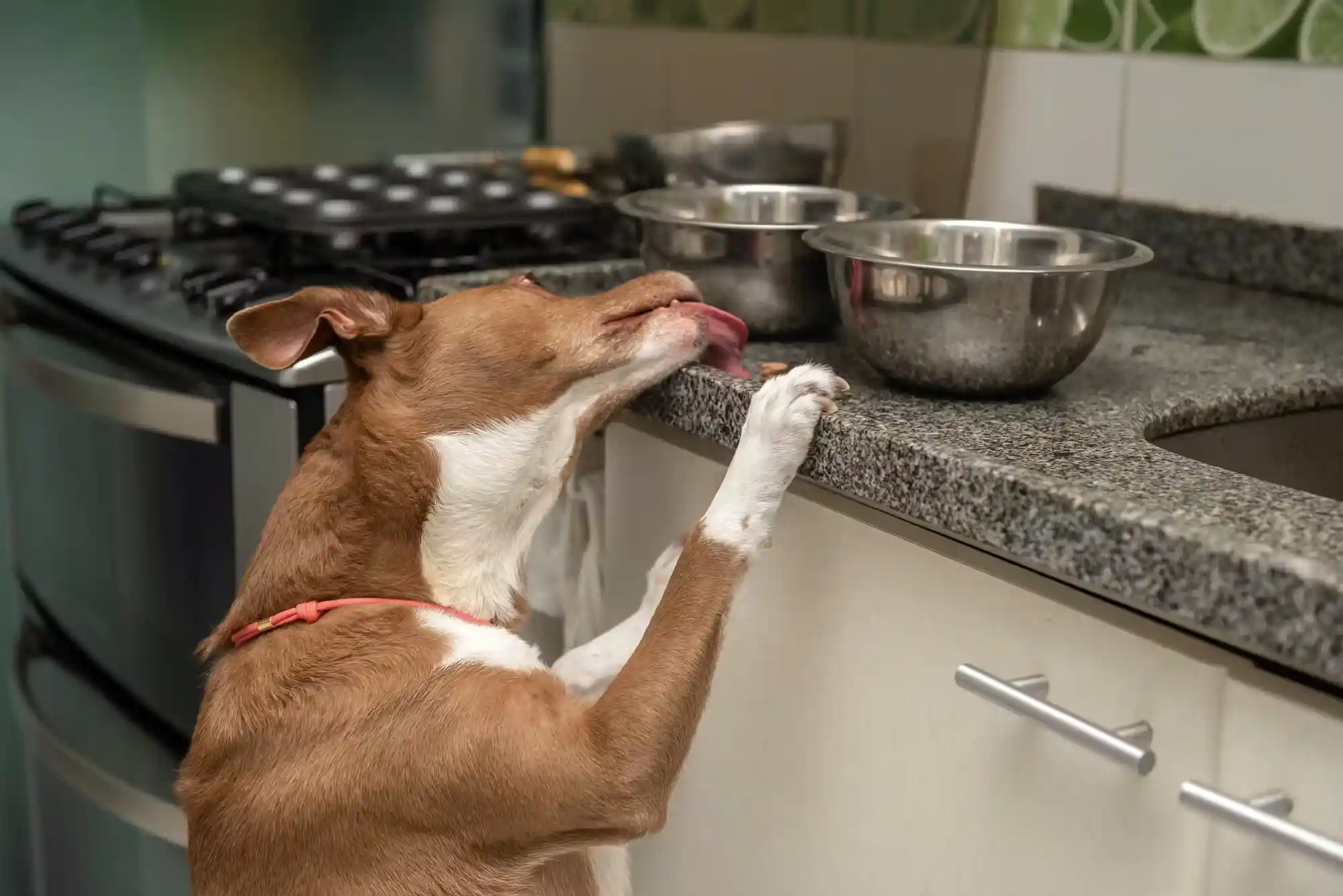
Counter surfing describes a dog putting their paws on a kitchen counter, stretching toward a worktop, climbing onto nearby furniture, or otherwise trying to reach something on an elevated surface.
For people, this can look like deliberate disobedience. From a dog’s perspective, however, the counter may simply be an excellent place to search for food.
If a dog finds something tasty there, the behavior becomes even more valuable. They do not need a person to reward them. The stolen food provides the reward immediately.
That is why learning how to stop counter surfing requires more than correcting the dog after the theft has already happened. The training needs to address what happens before the dog jumps.

Why Do Dogs Counter Surf?
Food Is a Powerful Reward
The most obvious reason dogs counter surf is food. Dogs have strong food-seeking instincts, and an unattended meal can be far more interesting than anything happening on the floor.
Even an occasional success can keep the habit going. A dog that finds food on the counter once may continue checking the same area because the possibility of another reward remains.
The Behavior Becomes a Habit
Imagine a dog checks the counter every afternoon. Most days, there is nothing there. One day, they discover a piece of chicken.
From the dog’s perspective, the search paid off.
This is why consistency matters. If food remains available occasionally, your dog has a reason to keep trying.
Interesting Smells Encourage Investigation
A counter does not have to contain visible food to be interesting. Crumbs, grease, food residue, dirty plates, and cooking smells can encourage a dog to investigate.
A clean-looking kitchen may still contain scents that are extremely attractive to a dog’s sensitive nose.
Boredom Can Contribute
Some dogs investigate counters simply because they have learned that the kitchen is an interesting place.
Mental enrichment, exercise, appropriate chewing opportunities, and food puzzles can help give dogs better outlets for natural behaviors. However, enrichment should complement training rather than replace basic kitchen management.
How to Stop Counter Surfing With Management
Before teaching new behavior, make the unwanted behavior difficult to practice.
Keep the Counter Clear
This is one of the most important parts of how to stop counter surfing.
Put food away rather than leaving it near the edge of the counter. Store leftovers in the refrigerator or closed containers, clean up crumbs, and avoid leaving dirty dishes unattended.
If your dog cannot access a food reward, they cannot repeatedly reinforce the counter-surfing habit.
The American Kennel Club recommends proactive management because even small amounts of forgotten food can teach dogs that countertops are worthwhile places to investigate.
Secure the Trash
The kitchen trash can be just as rewarding as the countertop.
Use a secure lid and consider placing the bin somewhere your dog cannot access it. If your dog is particularly determined, a cupboard, closed room, or physical barrier may be necessary.
This also reduces the risk of your dog eating something harmful.
Remove Climbing Opportunities
Some dogs use chairs, stools, or other furniture to reach higher surfaces.
Move these objects away from counters when possible. If your dog can easily climb onto a chair and then reach the countertop, simply telling them to stay down will not address the environmental setup.
Use Gates or Closed Doors
When you are unable to supervise your dog, prevent access to the kitchen.
A baby gate, exercise pen, crate, or closed door can be useful depending on your dog’s needs and comfort. Humane Society guidance also recommends physical management when the dog cannot be actively supervised.
Management is not a failure of training. It prevents your dog from practicing the old behavior while the new one is being learned.
Teach an Alternative to Counter Surfing
One of the most useful principles in dog training is to teach the behavior you want rather than focusing entirely on the behavior you dislike.
If you want your dog to stay off the counter, give them somewhere else to be.
A comfortable mat or dog bed near, but safely outside, the kitchen can become their designated station.
Teach “Place” or “Mat”
Start when the kitchen is quiet and there is no food on the counter.
Place the mat on the floor and reward your dog for approaching it. Gradually reward them for standing on it, sitting, and eventually lying down.
Once your dog consistently moves toward the mat, introduce a cue such as “place” or “mat.”
Keep training sessions short and successful.
The goal is for your dog to learn:
Going to the mat = good things happen.
Eventually, the mat becomes a predictable alternative to investigating the countertop.
The American Kennel Club recommends building this behavior gradually and increasing duration, distance, and distraction as the dog becomes more reliable.
Reward Your Dog for Staying on the Floor
Do not wait for your dog to make a mistake before interacting with them.
If your dog is standing calmly on the kitchen floor while you prepare food, reward that behavior.
If they look at the counter and then look away, reward them.
If they choose to lie down rather than investigate, reward them.
These small moments are valuable because they show your dog exactly which behavior earns reinforcement.
With repetition, your dog begins to understand that remaining on the floor can be more rewarding than jumping up.
Teach “Leave It” as a Supporting Skill
A reliable “leave it” cue can help when your dog becomes interested in food or another object.
Start in a quiet environment with a low-value item. Reward your dog for turning away from it and gradually increase the difficulty.
Do not begin by placing a roast chicken directly in front of an inexperienced dog and expecting perfect self-control.
Training should progress gradually.
“Leave it” is particularly useful when your dog notices something interesting before they reach the counter. It gives you an opportunity to redirect their attention while rewarding the choice to disengage.
What to Do When Your Dog Jumps on the Counter
If you catch your dog with their paws on the counter, stay calm.
Avoid yelling, chasing, or physically intimidating them. Instead, use a trained cue such as “off” or redirect them toward their mat if they understand that behavior.
As soon as their feet return to the floor, reward the appropriate behavior.
Operation Kindness similarly recommends calmly teaching an “off” cue and rewarding the dog once their feet are back on the ground.
The important part is not to accidentally create a dramatic game. For some dogs, chasing them around the kitchen can become exciting attention in its own right.
Why Punishment Usually Does Not Solve Counter Surfing
It is understandable to become frustrated when your dog steals food. However, punishment after the event does not teach the dog that the food itself was the problem.
If your dog grabs a sandwich and eats it, the reward has already occurred.
Scolding afterward may also make your dog wary of you without changing the motivation behind the behavior. Positive reinforcement and environmental management allow you to prevent the reward while teaching a desirable alternative.
The better question is not, “How can I punish my dog for jumping?”
It is, “How can I make staying down more rewarding and counter surfing unsuccessful?”
Make Kitchen Training Gradually More Difficult
Once your dog can remain on their mat in a quiet kitchen, slowly introduce distractions.
Start with simple movement around the room. Then handle empty plates or utensils. Later, introduce food preparation for short periods.
Eventually, practice while preparing a normal meal.
If your dog repeatedly gets up, the exercise may be too difficult. Reduce the distraction, shorten the duration, or increase the frequency of rewards.
Dog training works best when you build reliability rather than constantly testing the dog’s limits.
Reward Calm Behavior During Cooking
Cooking is often the moment when counter surfing becomes most tempting.
Before you begin preparing food, send your dog to their mat and provide appropriate reinforcement. Depending on your dog’s needs, this could include treats, part of their regular meal, praise, or a suitable food toy.
Continue rewarding calm behavior throughout the activity.
Over time, your dog can learn that the beginning of meal preparation is a signal to settle rather than investigate.
Be Consistent With Everyone in the Home
One person cannot successfully train a dog to stay off counters if another family member regularly gives them food from the kitchen.
Everyone should follow the same basic rule: food comes from appropriate places, not from countertops.
Guests should also avoid leaving plates, bags, or food where the dog can reach them.
Consistency removes confusion and makes the desired behavior easier for the dog to understand. Humane training resources repeatedly emphasize household consistency as an important part of preventing counter surfing.
Remember That Counter Surfing Can Be a Safety Issue
Counter surfing is more than a manners problem.
Kitchen counters can contain foods and objects that are dangerous to dogs. Depending on what your dog steals, they could ingest toxic foods, medication, sharp objects, packaging, or other hazardous materials.
For that reason, prevention should be taken seriously.
If your dog suddenly becomes unusually hungry, starts eating non-food objects, or shows other concerning changes in appetite or behavior, speak with a veterinarian. A sudden change may have a medical explanation rather than being purely a training issue.
How Long Does It Take to Stop Counter Surfing?
There is no universal timeline.
A dog that has only tried counter surfing a few times may change relatively quickly. A dog that has been stealing food for years may need considerably more management and practice.
Progress depends on factors such as the dog’s history, motivation, household consistency, and how often the dog gets opportunities to practice the unwanted behavior.
The key is to measure progress by behavior, not by a fixed number of days.
If your dog is checking the counter less often, responding to “leave it,” settling on their mat, and remaining calm during cooking, you are moving in the right direction.
Common Mistakes That Slow Training
Leaving Food Out “Just This Once”
One successful food theft can reinforce the habit. Keep counters clear while your dog is learning.
Using “No” Repeatedly
Repeated verbal corrections do not teach your dog what they should do instead. Pair boundaries with a clear alternative behavior.
Making Training Too Difficult
Do not immediately expect your dog to remain perfectly settled beside a counter covered with food. Build difficulty gradually.
Rewarding Only Perfect Behavior
Reward the small choices that lead to success. Looking away from the counter, returning to the mat, and remaining calmly on the floor are all useful behaviors.
Ignoring the Environment
Training becomes much harder when the kitchen constantly provides opportunities to steal food. Good management makes good behavior easier.
A Practical Long-Term Strategy
The most reliable approach to how to stop counter surfing combines prevention, training, and reinforcement.
Keep tempting items inaccessible. Prevent unsupervised kitchen exploration. Teach a strong alternative such as going to a mat. Practice “leave it” and “off” in manageable situations. Reward calm behavior before your dog feels the need to investigate.
As your dog’s habits improve, you can gradually reduce how frequently you reward them, while continuing to maintain sensible kitchen management.
The goal is not simply to stop one jump. The goal is to create a dog that automatically chooses another behavior when food is present.
Build Better Kitchen Habits
Learning how to stop counter surfing is less about correcting a “bad” dog and more about changing the environment and reinforcing better choices.
Keep counters clear, prevent unnecessary opportunities, teach your dog to settle somewhere appropriate, and reward calm behavior consistently. With patience, the kitchen can become a place where your dog understands exactly what is expected.
Start with one simple change today: clear the counter and teach your dog that their mat is where good things happen. With consistent practice, staying off the counter can become an ordinary part of your dog’s daily routine.
FAQs
Is counter surfing normal for dogs?
Yes. Dogs naturally investigate smells and accessible food, so counter surfing can develop as a normal food-seeking behavior. That does not mean you have to accept it. With management and training, dogs can learn different habits.
How do I stop my dog from jumping on the kitchen counter?
Keep the counter free from accessible food, prevent unsupervised access, and teach an alternative such as going to a mat. Reward your dog whenever they remain on the floor or settle in their designated place.
Should I punish my dog for counter surfing?
Punishment is generally not the most effective solution. Instead, prevent access to rewards and reinforce desirable behaviors such as staying on the floor, going to a mat, or responding to “leave it.”
How do I teach my dog to stay off counters when I am cooking?
Teach “place” or “mat” away from the kitchen distractions first. Gradually introduce cooking movements and food smells while rewarding your dog for remaining settled. If the dog struggles, make the exercise easier.
Why does my dog keep counter surfing even when there is usually no food?
Occasional success can maintain the behavior. If your dog sometimes finds food, the possibility of another reward can keep them checking the counter. Consistently removing access to rewards is therefore an important part of training.
Can a baby gate help stop counter surfing?
Yes. A gate can prevent kitchen access when you cannot actively supervise your dog. It is particularly useful during cooking, cleaning, or other situations when training cannot be your main focus.
What should I do if my dog steals something dangerous from the counter?
If your dog has swallowed something potentially toxic, sharp, or otherwise dangerous, contact a veterinarian or emergency veterinary service promptly. Do not assume that because your dog appears normal, the item is harmless.